
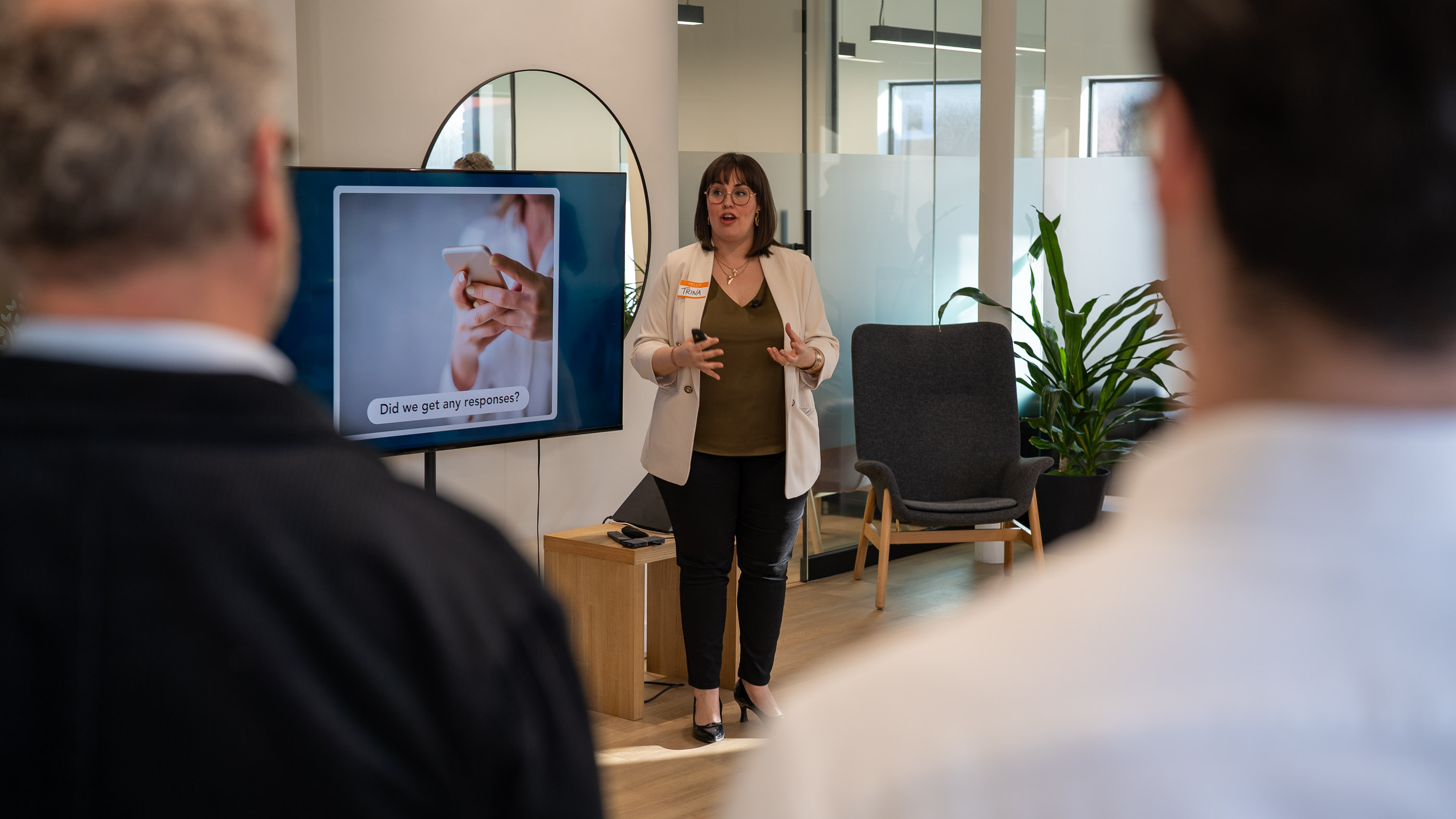
Last week I was invited to speak at an event hosted a friend of mine in Toronto – a room of CEOs, entrepreneurs, and business leaders. When my friend reached out, he made one specific request: make it relevant not just to the business owners in the room, but to the parents too.
So I did just that.
The divide is real – and it runs both ways.
The frustrations leaders are feeling about their young employees didn’t start at work. They started long before these young people ever set foot in a workplace.
I hear the same things from leaders almost word for word: they can’t communicate professionally, they ghost hard conversations, they don’t pick up the phone, they’re too sensitive to feedback.
But at my monthly Gen Z Professionals meetups – where young professionals speak freely with no managers in the room – I hear the other side just as clearly. Their managers have no life outside work. They never explain the why. They burned themselves out climbing a ladder Gen Z wants no part of.
According to a 2025 Deloitte survey, only 6% of Gen Z say their primary career goal is to reach a leadership position. Not because they lack ambition – because they’ve watched us burn out. And quietly decided: not like that.
The real question isn’t how do we fix Gen Z. It’s how do we meet in the middle.
It’s not a character problem. It’s a practise gap.
A large accounting firm recently had to add something new to their training program. How to pick up the phone.
To this generation, a ringing phone feels like a loss of control. The household landline is gone. The thousands of low-stakes interactions we accumulated without thinking – ordering pizza, answering for your parents – never happened for them.
This is fixable. But only if we stop writing them off and start meeting them where they are.
And to the parents in the room.

This problem doesn’t begin in the workplace. It begins at home.
Growing up, most meals in my house were an occasion. Sitting together was just what we did. Those meals were training me – how to listen, how to read a room, how to make someone feel genuinely welcomed. Skills I’d carry into every boardroom and client meeting of my career. Nobody called it professional development. But that’s exactly what it was.
I recently spoke with a room full of Gen Z’s who said they grew up scrolling through dinner – many families never sitting together. But several mentioned that now, living with roommates, they’d started eating together. And they loved it.
They didn’t grow up with the table. But the moment someone set one – they showed up for it.
Bring it back. Phones away. Real conversations. This is where the boardroom starts.
And I want to be clear – the dinner table is a metaphor as much as it is a practical suggestion. What it represents is intentional time spent in conversation, in community, being genuinely present with other people. That can look like a lot of things. A weekly family dinner. A volunteer commitment. A sports team. A faith community. A part-time job that puts a young person in a room with real people. Any intentional investment in real-world human interaction builds the same muscles. The dinner table is simply the most accessible place to start – and the one most of us have already let slip away without noticing.
The skills that will define your company over the next decade weren’t born in a boardroom.
They were learned at a dinner table.
And for a whole generation, that table was empty.
We can set it again. That’s the work.
About the Author
Trina Boos is the Founder and CEO of Boost Academy of Excellence, where she helps professionals master workplace etiquette and business skills for today’s evolving work environment. Drawing from her experience as former CEO of Boost Agents, Trina has placed thousands of professionals in leading organizations across North America.
Want more workplace insights like this? Subscribe to our newsletter for practical tips delivered directly to your inbox.
Learn more about our training programs:
– Corporate Training Programs
– Individual Courses
