
“Something felt off.”
That’s what hiring managers would tell me, over and over again, during my years running a recruitment agency. I’d place a candidate with impressive credentials and strong interview answers, and the feedback would come back the same way: great resume, solid experience, but something didn’t quite sit right.
When I’d probe deeper – what exactly felt off? – the answer was almost always the same: “They barely looked at me during the interview.”
I did what any good recruiter would do. I coached my candidates. Hold the interviewer’s gaze. Make consistent eye contact. Project confidence. Standard advice, right?
But then I started tracking who was receiving this feedback. And I couldn’t unsee the pattern: candidates from East Asia. South Asia. The Middle East. East Africa. Newcomers to Canada, overwhelmingly.
The “something was off” wasn’t about the candidates at all. It was about a cultural norm we’d mistaken for a universal truth.
What My Cross-Cultural Work Has Taught Me

Fast forward to today. After years of studying business etiquette, communication norms, and cross-cultural dynamics, I see those recruitment conversations completely differently. How many qualified professionals lost opportunities because they demonstrated respect the way their culture taught them? How many decisions were made based on a communication preference that wasn’t wrong – just different?
These questions came rushing back recently when a client asked me to facilitate a workshop for their leadership team. The focus? Eye contact. Just eye contact.
It seemed like such a specific topic – perhaps too narrow. But the deeper I dug into the research, the more I realized: this isn’t a narrow topic at all. Because eye contact? It’s not universal.
The Science Behind the Discomfort
Let me start with something that surprised me: research shows that mutual eye contact lasting longer than 4 seconds makes people uncomfortable – even when they know each other well. This isn’t about culture. This is hardwired human psychology.
Think about that. Four seconds. And yet, we tell job candidates – particularly newcomers – to maintain eye contact 60-70% of the conversation. We frame it as the hallmark of confidence and honesty.
But what are we really asking them to do?
Cultural Context Changes Everything

Here’s what I’ve learned from the research:
In Japanese culture, sustained eye contact is interpreted as aggressive or confrontational. Professional courtesy means looking away, or even at someone’s throat during conversation – not their eyes. What Westerners perceive as evasiveness is actually a demonstration of respect and appropriate professional distance.
Across South Asian cultures – India, Pakistan, Bangladesh, Sri Lanka – direct eye contact with superiors or elders signals disrespect. Averting one’s gaze isn’t timidity. It’s acknowledging hierarchy and showing deference to authority.
For women from conservative Middle Eastern contexts, sustained eye contact with unrelated men isn’t just uncomfortable – it can be culturally inappropriate. What we might interpret as shyness is often about maintaining modesty and navigating cultural and safety boundaries.
In many Indigenous cultures – First Nations, Aboriginal Australian, some Pacific Islander communities – prolonged direct eye contact is considered spiritually invasive. Looking down or away during conversation signals deep listening and respect, not disengagement.
Beyond Culture: Neurodivergence and Eye Contact

The cultural dimension is only part of the story.
Dr. Simon Baron-Cohen’s research at Cambridge University revealed something crucial about autism and eye contact. In tests measuring people’s ability to read emotions from photographs showing only the eye region, autistic individuals consistently scored lowest – not because they lack observational skills, but because their brains process eye contact fundamentally differently than neurotypical brains do.
Many autistic people describe direct eye contact as physically painful – like staring into bright lights. They report having to choose: make eye contact or process what someone is saying. Not both.
When we insist on eye contact as a measure of engagement, we’re not just applying a cultural standard. We’re asking neurodivergent people to expend cognitive resources on something that actually interferes with their ability to participate fully in the conversation.
Rethinking “Professional Standards”
Here’s what I thin about a lot — when hiring managers judge candidates by their ability to maintain Western-style eye contact, they’re not just screening for confidence. They’re inadvertently screening out:
- Cultural intelligence and global perspectives
- Neurodivergent communication styles
- People who’ve spent their entire lives learning that what we call “confidence,” their culture calls “disrespect”
- Trauma survivors for whom direct eye contact with authority triggers danger signals
The “professional standard” we’ve been using? It’s not a standard. It’s a preference – one that’s been excluding talented people.
A Better Question to Ask

Instead of asking “Did they make eye contact?”, what if we asked “Did they demonstrate engagement?”
Because engagement looks like many things:
- Nodding while listening
- Asking thoughtful follow-up questions
- Leaning slightly forward
- Providing specific, detailed responses
- Taking notes when appropriate
- Verbal affirmations (“I see,” “That makes sense”)
These signals of interest and professionalism don’t rely on a single cultural communication style.
The Real Work: Equipping, Not Erasing
The challenge isn’t to make everyone adopt Western eye contact norms. The challenge is to equip people to navigate Canadian workplace expectations while honouring their cultural identity.
That means:
For coaches and employment counsellors: Teach newcomers why Canadian employers value eye contact, not to shame their norms, but to give them full context for making informed choices. Offer alternatives like looking at the bridge of someone’s nose (which appears identical to direct eye contact) or focusing on brief glances during key moments.
For hiring managers and leaders: Expand your definition of “professional presence.” Train yourself to notice engagement signals beyond eye contact. Recognize that your discomfort with someone’s communication style might be about unfamiliarity, not unprofessionalism.
For organizations: Audit your interview processes. Are you evaluating competency and qualifications, or are you prioritizing communication styles that match your own?
Moving forward
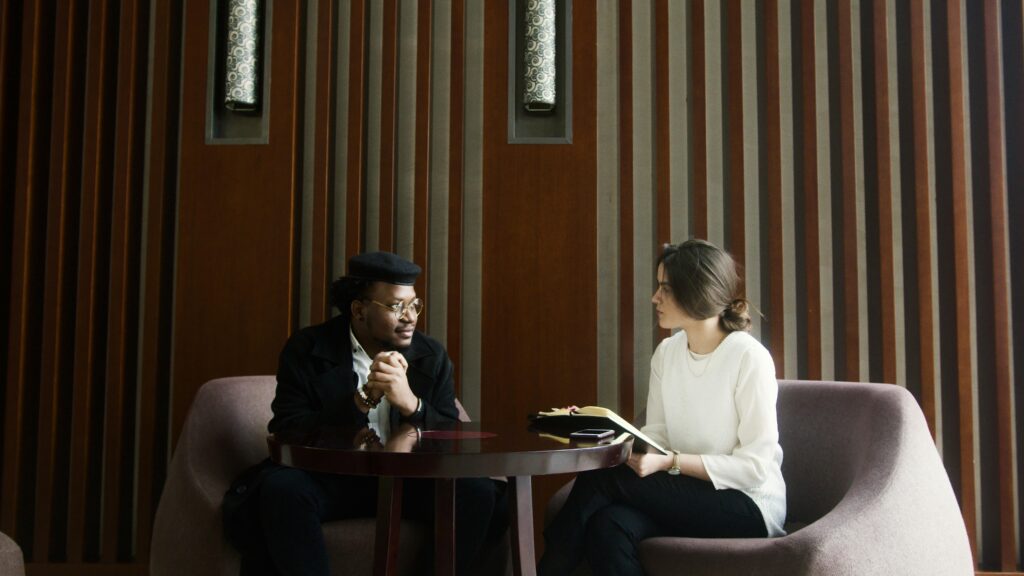
I think about those conversations from my recruitment days differently now. The hiring managers who said “something was off” weren’t trying to discriminate. They genuinely believed they were reading trustworthiness and confidence.
But intention doesn’t erase impact.
If we want to build truly inclusive workplaces – not just diverse ones – we have to question the assumptions embedded in our “professional standards.” We have to get uncomfortable with our own discomfort.
Because the next time someone says “They didn’t make eye contact, so something felt off,” the question isn’t “What’s wrong with the candidate?”
The question is: “What am I missing?”
About the Author
Trina Boos is the Founder and CEO of Boost Academy of Excellence, where she helps professionals master workplace etiquette and business skills for today’s evolving work environment. Drawing from her experience as former CEO of Boost Agents, Trina has placed thousands of professionals in leading organizations across North America.
Want more workplace insights like this? Subscribe to our newsletter for practical tips delivered directly to your inbox.
Learn more about our training programs:
– Corporate Training Programs
– Individual Courses
